The Companies Advancing Pharma’s Next Digital Revolution

The pharmaceutical industry is in the midst of another wave of digital transformation.
Since the advent of the digital age, a series of distinct digital transformation waves have swept through the sector, with each building on the last to reshape how medicines are discovered, developed and delivered.
The first wave, spanning the 1990s and early 2000s, focused on digitisation at a time when almost every industry was undergoing a similar transition.
Paper-based processes gave way to electronic clinical trial systems and digital laboratory records, improving efficiency but often leaving data locked in siloed systems.
The next wave centred on connectivity. The rise of cloud computing, advanced analytics and IoT technologies allowed pharmaceutical companies to link research, manufacturing, supply chains and commercial operations, laying the foundations for a connected, data-driven enterprise.
The arrival of AI marked the third wave. Initially applied to standalone use cases such as drug discovery, clinical trial optimisation and pharmacovigilance, AI quickly proved its value in accelerating research and improving decision-making across the pharmaceutical value chain.
All this digital upheaval has led to today, where the industry finds itself amid its fourth wave of digital transformation, with AI no longer confined to isolated projects or uses.
Instead, pharmaceutical companies are embedding generative AI, foundation models, digital twins and autonomous laboratories throughout core operations, creating AI-native organisations in which intelligent systems underpin every stage of the medicine lifecycle.
- 1. Digitisation.
- 2. Connected Pharma.
- 3. AI and Automation.
- 4. AI-Native Pharmaceutical Enterprise.
This fourth wave can be broken down into five core pillars:
1. AI-native research and drug discovery
Key technologies: Foundation models, generative AI, multimodal AI, lab automation and digital biology.
Where the third wave saw AI applied to individual discovery tasks in isolation, it is now becoming embedded across the entire process, including target identification and molecule design to biomarker discovery and candidate optimisation.
The key shift is companies pairing generative AI with laboratory automation to create autonomous or semi-autonomous discovery workflows, closing the loop between AI-generated hypotheses and physical experimentation.
2. Intelligent clinical development
Key technologies: AI trial design, real-world evidence, digital biomarkers, remote monitoring and predictive analytics.
Clinical development has become genuinely data-driven rather than data-supported.
AI now shapes protocol design, identifies suitable trial sites and participants, predicts recruitment challenges and analyses real-world evidence at scale.
3. AI-enabled manufacturing and supply chains
Key technologies: Digital twins, Industrial IoT, predictive maintenance, robotics and computer vision.
Linking factory floors to upstream supply chains, the connectivity wave laid the groundwork here, but this pillar has now evolved from connected to intelligent.
Digital twins, IoT sensors and predictive analytics actively optimise production, anticipate quality issues before they occur and build resilience into supply chains in real time.
Sustainability and regulatory compliance are also now designed into these systems rather than layered on top.
4. Unified data and enterprise AI
Key technologies: Cloud platforms, knowledge graphs, enterprise AI agents and generative AI.
If wave two connected pharmaceutical enterprises, wave four puts unified data to work.
AI-powered cloud platforms bring together R&D, manufacturing, regulatory, commercial and patient data to enable generative AI copilots and autonomous agents to surface insights, automate workflows and make decisions with minimal human input.
5. Digital patient and healthcare ecosystems
Key technologies: Connected health platforms, remote monitoring, digital therapeutics, patient engagement and real-world data.
This is where the fourth wave extends furthest beyond earlier ones: for the first time, digital transformation runs all the way to the patient.
Companion apps, remote monitoring, digital therapeutics and provider partnerships mean a medicine's digital footprint no longer ends at market launch.
Real-world data generated post-launch now feeds continuously back into clinical development, pharmacovigilance and commercial strategy.
- NVIDIA: With a market cap in excess of US$5tn, NVIDIA provides the AI computing infrastructure powering next-generation pharmaceutical research.
- Microsoft: The tech giant enables pharmaceutical companies to deploy AI at scale through cloud infrastructure, enterprise data platforms and generative AI tools.
- IQVIA: Combining AI, real-world evidence and one of the world's largest healthcare datasets, IQVIA accelerates clinical development and generates regulatory-grade insights.
- Dassault Systèmes: Through virtual twins, scientific modelling and connected manufacturing platforms, the French software giant optimises drug development and medical device production.
- Palantir Technologies: Integrates fragmented, siloed data into AI-powered platforms that help pharmaceutical companies streamline research, manufacturing and supply chain decision-making.
- Isomorphic Labs: The London-based firm applies AI models to redesign drug discovery, enabling researchers to identify and develop promising medicines.
- Veeva Systems: As the digital backbone of the pharmaceutical industry, Veeva’s cloud applications unify clinical, regulatory, quality and commercial operations.
- Recursion Pharmaceuticals: The TechBio firm combines AI, automation and one of the world's largest biological and chemical datasets to accelerate drug discovery.
- Siemens: The engineering giant advances intelligent manufacturing technologies, industrial automation and digital twins to improve production efficiency, quality and safety.
- Insilico Medicine: Insilico uses generative AI to accelerate the development of novel drug candidates from target identification through to clinical trials.
NVIDIA
NVIDIA is building the infrastructural backbone powering pharma’s AI-native future.
Its AI infrastructure, software platforms and foundation models are enabling everything from drug discovery and clinical development to smart manufacturing and enterprise-wide generative AI.
Partnerships with pharma’s biggest players, including providing the infrastructure behind the purported “most powerful AI factory in life sciences” with Bristol Myers Squibb, its suite of industry-specific platforms, such as BioNeMo and Isaac For Healthcare, as well as providing open-source robotics simulators to accelerate medical robotics development, all place the company at the centre of the industry’s next digital revolution.
To provide a sense of NVIDIA’s vast healthcare exposure, its portfolio now spans, but is not limited to:
- BioNeMo – a platform of foundation models for protein structure prediction, molecular generation and drug discovery.
- DGX SuperPOD – AI supercomputing infrastructure used by pharmaceutical companies to train large biological models.
- NVIDIA AI Enterprise – software for deploying generative AI securely across regulated environments.
- Omniverse – digital twin technology for manufacturing facilities and lab
- oratories.
- Clara – AI platform supporting medical imaging, genomics and computational healthcare.
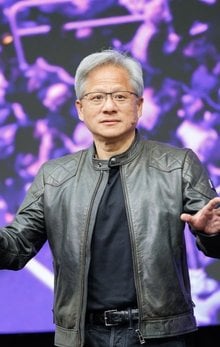
Discussing the role of computing in pharmaceutical research, Jensen Huang, CEO of NVIDIA, says: “I can’t imagine a more worthy field to apply computer science to. Hopefully we can bend the arc of history.”

Microsoft
Alongside NVIDIA, Microsoft’s digital products are the leading foundational layer powering pharma’s latest wave of digital transformation.
But while NVIDIA provides accelerated computing, AI frameworks and foundation model infrastructure that make advanced AI possible, Microsoft provides the cloud, data platform, security and enterprise AI environment that enable pharmaceutical companies to deploy those capabilities at scale across the business.
From Azure and Copilot to Fabric and Cloud for Healthcare, Microsoft’s diverse suite of healthcare-specific and sector-agnostic technologies allows pharmaceutical companies to unify data from R&D, clinical trials, manufacturing, regulatory affairs and commercial operations, then layer AI capabilities on top.
Microsoft’s life sciences strategy has accelerated rapidly over the past 18 months. Standout developments include its five-year strategic collaboration with Haleon to scale AI across the consumer health company's global operations and news that NHS England plans to roll out Microsoft 365 Copilot to more than 500,000 clinicians and support staff.
Microsoft is evolving from a cloud provider into the AI operating platform for life sciences. Through Azure AI Foundry, Copilot, agentic AI and strategic partnerships with pharmaceutical and healthcare organisations, it is enabling AI adoption across research, clinical development, manufacturing and enterprise operations.
IQVIA
IQVIA is transforming how pharmaceutical companies develop clinical trials and ultimately, bring new drugs to market.
Its capabilities span almost every stage of clinical development to accelerate drug development, including AI-assisted protocol design, patient recruitment optimisation, investigator site selection and decentralised clinical trials.
IQVIA’s AI strategy has accelerated in 2026, reinforcing its position as a leading digital transformation partner for the pharmaceutical industry.
“IQVIA.ai enables organisations to move faster and smarter while meeting the rigorous standards of trust and reliability that are required in the industry. ”
In March, the company launched IQVIA.ai, an agentic AI platform developed with NVIDIA that combines proprietary healthcare data with AI agents and automation to support research, clinical development, regulatory affairs and commercial operations.
Commenting on the launch, Bernd Haas, SVP of AI & Technology Solutions at IQVIA, describes how the company is accelerating digital transformation: “By bringing together our data, expertise and Healthcare-grade AI within a unified, agentic platform, IQVIA.ai enables organisations to move faster and smarter while meeting the rigorous standards of trust and reliability that are required in the industry.”
A month earlier, IQVIA expanded its footprint in drug discovery by acquiring Charles River Laboratories' discovery assets, extending its capabilities further upstream in the R&D process.
The company has also deepened AI-enabled partnerships, including a collaboration with Kexing Biopharm to accelerate biosimilar development.
Did you know?
Company portals








Executives
Bernd Haas
EVP AI & Technology Solutions
Jensen Huang
Founder and CEO