
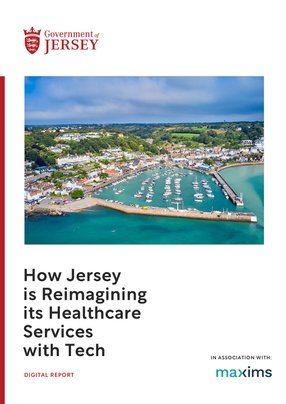
How Jersey is Reimagining its Healthcare Services with Tech
Nestled off the French coast is the island of Jersey, the largest in the English Channel. Boasting a population of around 104,000, the self-governing British crown dependency is undertaking a comprehensive digital transformation of its healthcare services to benefit the health and wellbeing of its population by reimagining how public healthcare is delivered through technology, partnership and cultural change.
Leading the charge is Martin Carpenter, the Government of Jersey’s Healthcare CIO. His vision extends beyond simply digitising existing processes, aiming to create a responsive, data-driven healthcare ecosystem that puts both citizens and clinicians at the centre.
The island's size, while presenting logistical challenges, offers distinct advantages. As Martin explains, changes can be implemented more quickly than in larger jurisdictions, feedback loops are shorter and the impact of improvements is immediately visible across the community.
“I really enjoy the fact that healthcare is very much about doing good,” Martin says of his role at the intersection of tech and health.
Digital transformation of Jersey’s healthcare
Jersey faces the same healthcare challenges as all western economies, with an ageing population, shortage of health and care professionals and rising treatment costs all contributing to pressure piling onto the sector. The island’s response centres on digital transformation to enable prevention rather than just treatment.
As it stands, Jersey's current digital maturity position is stark but this, for Martin, presents opportunity.
“On the HIMSS’ scale from zero to seven in terms of health system digital maturity of care continuity, CCMM, we’re at level zero,” Martin says. “Out of 26 jurisdictions where that assessment has been carried out, we are number 26. This means we do have a long way to go, but the good news is we don’t have a lot of legacy technology to wade through in order to accelerate our ambitions.”
The Government of Jersey’s transformation programme builds on the island's recognition of digital as core to economic development. For example, Jersey already has fibre to every home and is rolling out next-generation 5G technology. Digital Jersey, a government-backed organisation, also supports skills development and issues grants for innovative projects.
“What’s also really encouraging – thanks to Jersey’s nature as a small island – is it’s hugely entrepreneurial,” Martin adds. Many are working on building digital solutions and leveraging them from a citizen point of view, with the ambition to curate simpler, more joined up services, fewer systems, more seamless experience. Having reliable infrastructure and leveraging the big promise of AI will allow us to improve services and reduce cost.
“Organisations like Digital Jersey recognise all of the good work that people are doing in Jersey and support digital skills development via its IT skills academy. The Impact Jersey fund issues grants to people for things like real-time housing sensors and drone emergency services – things that have a real tangible benefit for islanders.”
As it stands, the island’s healthcare system currently operates in digital silos, as data sits separately across GPs, the hospital, adult social care, community nursing and pharmacy – meaning each provider holds a different view of patients' health information. This is where Martin’s vision comes in – to turn this on its head and create a streamlined, digital-first approach to healthcare for all in Jersey.
He explains: “By maturing the digital health environment, that will ultimately translate into better health outcomes for islanders, better value for money in terms of how we spend money on health and care provision and improved access. All areas currently have a different view of Islanders' health information, meaning we’re really behind the curve in terms of working at a system level to bring that data together.
“When we do, we can expect significant improvements in people’s health outcomes because health interventions will be a lot more complete with a better view of what's going on.”
Building a culture of innovation
The Government of Jersey's transformation programme has people, and communities, at its core – both when it comes to who it serves and the people that run the service, an approach focussed on challenging the status quo.
This approach centres on creating environments where people can work authentically. “The environment allows me to be myself,” Martin says. “When you are yourself in an organisation, you are performing at your best.”
The team is deliberately composed of people who challenge conventional thinking, bring creative approaches and refuse to accept that things must continue as they’ve always been done. These disruptors, in the best sense, are essential for transformation in Martin’s eyes. But disruption requires careful management.
“Taking everybody with you is a real challenge,” Martin shares. “Everyone’s got their own particular way of doing things, so we’re acting as a change agent, finding a fine balance between wanting to shake things up and taking people along on that journey with us.”
The Government of Jersey uses workshops to identify key issues and create shared understanding. It also leverages the benefits of coming from and working among a tight interconnected community, with lots of people sharing experiences and wanting equally to fix issues affecting the island’s population.
“We’re encouraging people to tap into their inner creativity, acknowledging that it’s okay to – and that we will – fail along the way and to be open about that failure,” Martin emphasises. “Failure doesn’t mean we’re not trying hard enough, it means we’re pushing the boundaries of where we need to go. We have to be able to do the best that we can with the knowledge that we have and be prepared to pivot on that basis as well.”
This is where cross-collaboration and ownership is most important, he adds. Encouraging teams to push boundaries, teams are given permission to experiment and fail safely. “Having open and transparent conversations – and also being human – is really important,” he adds.
The importance of partnership
IMS MAXIMS, a provider of electronic patient record (EPR) systems, has become a critical partner in Jersey’s digital healthcare journey.
“MAXIMS is a critical partner in terms of the work that we’re doing to deliver a functioning EPR for our hospital,” Martin explains. “I’d say we're probably about 80% of the way there with what we’ve set out to achieve as we’ve got some work to do around clinical noting, but I’m really excited to roll out the MAXIMS Smart platform – it’s going to be a game changer for us. It will allow us to rapidly build views of data that clinicians want.”
The flexibility and agility of MAXIMS is a major draw. As a smaller provider, its nimble nature allows it to quickly adapt to the Government of Jersey’s needs, which benefits residents directly as a result. The partnership is already longstanding, having worked with the government for several years. For Martin, MAXIMS is not just a supplier but a genuine partner, with the collaborative nature of the relationship also reflecting the government’s broader philosophy about how technology transformation should work.
“Wider partnerships are also crucial,” Martin says. “In Jersey, a lot of business revolves around meeting people face-to-face, establishing relationships and working with people. We, for example, work closely with the voluntary sector, and are looking at how we can partner together for the benefit of Jersey. We can’t afford to keep reinventing the wheel, so our NHS and ex-NHS colleagues are also going to be crucial to some of the plans we’ve got in place around helping to mature our digital health ecosystem.”
The future of tech-driven health in Jersey
Looking ahead, Martin’s priorities underpin supporting the Government of Jersey’s implementation of a single patient record, integrating data and further uniting Jersey’s healthcare system with technology. Jersey is also looking to leverage a grant from Digital Jersey to Family Nursing which will enable remote monitoring and virtual wards. This will allow connection to the likes of people’s smartwatches and other devices, with permission, to give Jersey’s healthcare professionals a much greater understanding of people's health and enable advanced data-driven public health services.
Information governance is another critical focus, giving islanders transparency and choice about how their data is shared beyond direct care purposes. Addressing organisational and cultural change, Martin and his team is working on creating agile working methods that can adapt to new technologies and changing requirements, alongside completing the IMS MAXIMS EPR implementation.
“Getting into a way of working which is agile and responsive – meaning we can take on new information as it comes to us – means people may want our services delivered slightly differently than the original plan,” Martin says. “Creating a culture that facilitates the ability to deliver high-quality digital transformation at pace – and at good value for money – is going to keep us busy for the next 12 to 18 months.”