
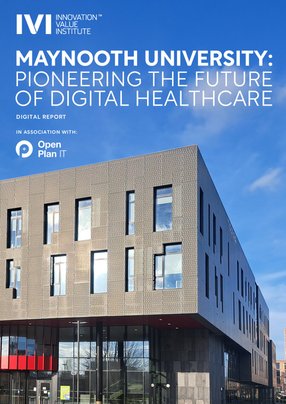
Maynooth University: Pioneering the Future of Digital Health
Healthcare systems around the world are currently facing mountainous pressures. From aging populations, to rising costs and workforce shortages, millions of patients are awaiting treatment.
Spending in the Republic of Ireland’s healthcare sector alone has increased by €8 billion (US$8.3bn) in recent years, yet productivity gains achieved are a paltry 3.5% and waiting lists continue to grow. With these factors in mind, universities have emerged as vital innovation hubs to enact transformation. Their position outside traditional healthcare hierarchies, combined with academic freedom and research capabilities, enables them to envisage and experiment with new delivery models.
These institutions ultimately work to bridge the gap between theoretical research and practical implementation, with their ability to test solutions in real-world settings.
Maynooth University's Innovation Value Institute exemplifies this approach. A Guided Digital Health Open Collaborative Ecosystem (OCE) led by Professor Martin Curley, is a systematic collaborative effort to re-imagine and reshape healthcare through technology and a new innovation methodology, Open Innovation 2.0.
Its initiatives span from practical applications of AI to the development of open-source healthcare platforms, demonstrating the potential for academic institutions to drive industry-wide change.
“Our mission is to drive a structural change in the way companies and organisations and governments get value from technology,” explains Martin. “It's about solving real world problems, but also then contributing to and taking advantage of the academic literature.”
COVID-19: Disrupting tradition in healthcare
Industry challenges remain from the COVID-19 pandemic, where countless systemic vulnerabilities were exposed. This, in turn, has accelerated the push toward digital transformation in healthcare delivery.
The pandemic also pushed rapid innovation at the Health Service Executive (HSE), where Martin was Director of the Digital Transformation and Open Innovation. Within 48 hours, his team deployed remote monitoring solutions for patients with COVID with an Irish SME PatientMPower, followed by automated real-time respiration rate monitoring that provided early warning of patient deterioration.
“Working with SME PMD Solutions we put novel respiratory technology into 23 hospitals in four months. One of our top clinical engineers said that, in peace time, that might've taken five years or never happened at all,” Martin says.
The pandemic highlighted structural issues in healthcare delivery. “The healthcare system in the US has some of the most advanced equipment and facilities. But what happened during COVID was that the hospitals started to empty, but their for-profit business model depended on the hospitals being full,” Martin explains.
What the pandemic also highlighted is that these traditional healthcare models – built around hospital-centric care and reactive treatment – are struggling to meet contemporary demands. In fact, the World Health Organisation (WHO) reports that half the global population lacks access to essential health services, while developed nations grapple with unsustainable cost and demand increases.
As a result, healthcare providers are increasingly turning to digital solutions, with the global digital health market reaching US$211bn, according to Grand View Research.
Maynooth University’s Innovation Value Institute, which is modelled on Carnegie Mellon's Software Engineering Institute, also incorporates inspiration from MIT's Centre for Information Systems Research and is leading the charge on digital health transformation introducing a new paradigm to drive a revolution in health. It focuses on structural changes in how organisations extract value from technology and operates through design science research, a methodology that combines practical problem-solving with academic rigour.
This approach enables the Institute to address real-world healthcare challenges while contributing to academic literature.
“Academic freedom provides more autonomy than in a hierarchical health organisation,” Martin explains. “Healthcare is notoriously hierarchical, with command and control and multiple levels of permissions required.”
Advancing the modern healthcare system
To overcome some of these challenges, Maynooth University’s Institute is currently focusing on what Martin refers to as ‘Stay Left, Shift Left, 10X’ – a framework for healthcare transformation. This approach prioritises keeping patients well at home, expediting hospital discharge and achieving tenfold improvements in healthcare.
“Instead of wasting time making car journeys and sitting in traffic, many things can be done from home,” Martin explains. “It is also about getting patients home from hospital as quickly as possible. The ‘10X’ refers to using digital to do things ten-times better, ten-times cheaper, ten-times earlier, ten-times better and ten-times higher volume.”
During the pandemic, the HSE demonstrated this approach through collaboration with SME Salaso, with the partnership enabling pulmonary patients to conduct rehabilitation at home under remote supervision. The Cystic Fibrosis unit in Galway University Hospital achieved a 14X or 14-fold productivity improvement through the use of tele physiotherapy during Covid, also saving patients on average 895 euro.
The framework draws from evidence gathered across 40 different healthcare scenarios, presented at the UN General Standard Digital Health Symposium and has evolved into what fellow leaders Digital Doctor John Sheehan and AI health entrepreneur Richard Jones call "Curley's Law" – a principle suggesting that compounding 10X digital healthcare innovations have the potential to increase average longevity, address equity issues and put global health systems on a more sustainable footing.
For example, Allview’s Tele-dermatology in Ireland reduced time to access care by 10X from 2+ years to 2 weeks and with one in five cases presenting with skin cancer this earlier detection can result in a 10X reduction in mortality and 10X reduction in costs. Similar to Moore’s Law for semiconductors, Curley’s law, whereby the application of digital technologies to healthcare consistently delivers 10X returns in terms of speed, cost-efficiency and overall effectiveness is both an empirical observation and an aspiration goal/competitive challenge for the global healthcare industry.
“We have a lot of evidence that by using digital tools, we can make things cheaper, better, faster and – most importantly – we can create better outcomes for patients,” Martin says. “We're putting in the plumbing, and we hope to demonstrate at scale in Ireland how you can get a fully functioning modern health system that's very much focused with the patient at the centre.”
The Institute demonstrates this approach through practical applications. Working with HSE Social Inclusion with ex-NHS leader Maxine Radcliffe, a distributed clinical team supports 15,000 patients through new digitally enabled care models.
“We believe this is the future of healthcare in Ireland, but could also potentially be the basis of a new global health system,” Martin shares. “The solutions we are going to demonstrate at scale in Ireland will show how you can get a fully functioning modern health system that very much places the patient at the centre and leverages open-source software.”
Technology integration forms a core component of this transformation, with Maynooth University investigating use of AI for patient education and clinical support. AI tools like Nuance, a Microsoft subsidiary specialising in voice recognition, enable the transcription of doctor-patient interactions and can generate appropriate documentation, thereby increasing consultation efficiency.
“Whilst average life expectancy continues to improve, we believe we can maintain this and in fact improve life expectancy by using these ‘Stay Left, Shift Left technologies.”
Martin’s team also advocates for healthcare delivery through smartphones. He explains that they are working to build a health system centred around the mobile phone, which is then supported by IoT devices and AI assistance.
“The mobile phone is the most important medical device of the 21st century,” he says. “AI, coupled with the Internet of Things (IoT) and cloud computing, is going to enable us to dramatically transform healthcare. While we can't guarantee outcomes, this technology increases the probability of longer, healthier lives at lower costs.”
He adds: “AI is improving both productivity and accuracy. Through consistent application of Stay Left, Shift Left-10X, aka Curley's Law, we could potentially add an average of two-and-a-half years of healthy life to everyone's lifespan every five years using Digital and AI technology.
“AI will become prevalent in healthcare, not only through AI health assistants working with us on advanced diagnostics, but also importantly in driving behavioural change. It has the potential to bring the best knowledge and nudges to the doctor and patient, which offers augmented intelligence.
“It’s going to transform education and healthcare and we’re still at the beginning. As Hans Vestberg said: “The pace of change is never going to be this slow again”, which is really exciting.”
Open Plan IT: Scaling the transformation roadmap
Maynooth University’s approach to patient engagement follows a structured progression from engagement to enablement, education, empowerment and excellence. According to Martin, this methodology – termed the Patient Capability Maturity Framework – co-developed with Richard Wyatt Haines of HCI, represents a shift from traditional doctor-centric models to patient-led healthcare.
Collaboration and trust are integral to this research. “We work closely with some of my ex-colleagues from HSE as well. The ability to collaborate from the outside is really attractive,” Martin shares. “We have more freedom to orchestrate such an ecosystem and we can innovate a lot quicker as a result.”
As part of this approach, the university is also partnered with Open Plan IT, a UK-based social enterprise that specialises in open-source healthcare solutions. Open Plan IT has established an Irish entity at Maynooth University and collaborated with HSE to create a digital health platform that serves more than 15,000 patients with complex needs.
“They've done amazing work and we have a really strong and high performing collaboration between Open Plan IT, the Innovation Value Institute and HSE,” Martin says. “We have the privilege of working with Open Plan IT and they have stood up a completely new digital health platform to allow distributed network centric care of patients with really complex needs.
“This is providing next generation capabilities for the HSE clinical team, also enabling them to have real-time multidisciplinary team discussions on patients or outbreaks.”
The platform development followed a living lab process, scaling from single patient trials to its current scope. This approach aligns with Open Innovation 2.0 principles, emphasising practical implementation and iteration in clinical settings.
Martin explains his team is currently working on a significant research grant proposal that will be submitted in early 2025. This proposal aims to address significant challenges within the healthcare sector leveraging disruptive technologies, with the vision extending beyond Ireland as global healthcare continues to confront significant upheaval.
"Our work has already saved lives, and even one life saved makes this worthwhile. While our initial goal is to transform healthcare in Ireland, we plan to develop this into a platform and a design pattern that can be deployed in other countries,” he says.
"Transforming an industry is really hard but we are assisted by the breakthrough methodology Open Innovation 2.0, which requires focusing on co-innovation rather than just research. As part of this, we host an annual Digital Health Symposium during the UN General Assembly in New York and an international Digital Health Summer school to help educate and radically co-innovate a new kind of health system.
“We're very much about purpose, passion, people/patients and progress. Ultimately, if we do that right, this could be very profitable as well.”
Make sure you check out the latest industry news and insights at Healthcare Digital and be part of the conversation at our global conference series, Manufacturing LIVE.
Discover all our upcoming events and secure your tickets today.
Healthcare Digital is a BizClik brand
Company portals

Executives

Martin Curley
Professor of Innovation at Maynooth University