
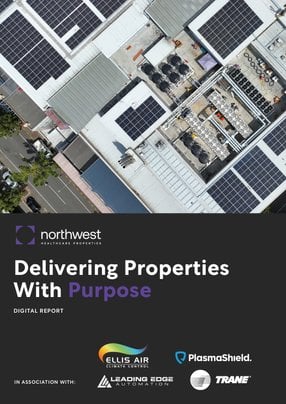
Northwest Healthcare: delivering properties with purpose
In healthcare, small margins matter. Gone are the days when delivering the best possible outcomes relied solely on highly skilled clinicians, industry leading research or the most innovative medical devices. Instead, every aspect of the healthcare experience, including the very infrastructure within which patients are treated, needs to be optimised. Even down to details like air quality, natural light volumes, how comfortable the environment is or its energy dependence.
Tony Gill and his colleagues at Northwest Healthcare call this ‘properties that serve a greater purpose’. Their work involves delivering healthcare real estate that looks to be resilient, high-performing and sustainable to enable the best possible health outcomes for the global communities that rely on them.
Tony has spent more than 20 years in building management and technical operations across the retail, commercial, industrial and health sectors. Over this period, he has worked with some of Australia’s leading companies.
Tony joined Northwest Healthcare, which is part of a global healthcare real estate trust, in 2021. In his role as Senior Director of Operations and Sustainability for ANZ, he is responsible for leading the region’s operational performance and delivery of the strategy across the company’s Australian and New Zealand portfolio, which forms part of a broader global portfolio spanning 169 properties in seven countries including Australia, New Zealand, Canada, Germany, Brazil, the Netherlands and the US.
“Our goal is simple, but powerful: to enable better health outcomes by delivering high quality and future-ready healthcare infrastructure,” says Tony. “We focus exclusively on healthcare assets including acute hospitals, mental health centres, medical office buildings, research facilities and specialist clinics. Our ethos is that these aren’t just properties, they’re critical infrastructure that people rely on 24/7.
“To deliver on that, we take a long-term approach,” he adds. “That means investing heavily to ensure our assets aren’t just functional, but aim to be high-performing, resilient and sustainable. Focusing our efforts on building assets to support better patient outcomes is key to our strategy. Whether decarbonising hospitals, upgrading buildings or improving environmental quality, our vision is to create healthcare environments that are safe, efficient and support the wellbeing of patients and professionals.”
Establishing a robust foundation
Sustainability is critical to the modern built environment, a sentiment that Tony has seen evolve over his career. “It’s shifted from a compliance-driven exercise to a strategic business priority, more rapidly post-Covid,” he affirms.
“In healthcare in particular it’s now about resilience, air quality and energy independence – there’s a deeper understanding about how buildings contribute to better health outcomes.”
Tony brought this mindset to Northwest Healthcare in 2021 when, he says, sustainability in the healthcare real estate sector was in its early stages.
On his arrival Tony set about pushing the company’s ambitions even further. “One of my first priorities was building a clear, data-informed energy baseline through data collection, mapping emissions, energy, water and waste across every asset,” he explains. “We followed that with detailed energy audits, which gave us the insight to understand where we stood and, more importantly, where we needed to go.”
From this data, Tony and the team developed tailored carbon reduction roadmaps for the 75 properties in the regional portfolio. This included lighting upgrades, air conditioning optimisation, solar feasibility studies, electrification and equipment lifecycle planning.
“We didn’t just talk about decarbonisation," Tony states, “we mapped it out in detail, property by property to prioritise activities across the regional portfolio. Since, sustainability has been embedded into everything we do, helping us deliver national firsts and earn Global Real Estate Sustainability Benchmark (GRESB) sector leadership.”
Driving better patient outcomes
Such a high level of detail to sustainability and performance is critical in a sector like healthcare, where challenges around pace of transformation, the implications of downtime and managing multiple stakeholders persist.
“Healthcare and sustainability are deeply connected,” Tony explains. “The environments we build have a direct impact on patient wellbeing, clinical performance and long-term health outcomes. We can’t get away with just ticking a box – we have to create spaces that are safe, healthy and resilient for some of the most vulnerable people.
“We operate in a 24/7, high-stakes environment where systems need to be efficient, reliable and future-ready,” he continues. “That’s where sustainability comes in – not just to seek to lower emissions, but to strengthen our assets against energy volatility, climate risk and operational disruptions.”
Northwest Healthcare has a long history of design excellence and building execution that enables this. Its Canadian listed parent was founded in 2004 and has grown from a local Ontario-based business to a global leader in healthcare real estate with assets under management worth US$8.2bn.
Over time, Northwest Healthcare’s approach has evolved from focusing on pure build to an integrated model that brings together design, operational performance and sustainability from the outset. As a result, Northwest Healthcare has achieved 6 Star Green Star - Design & As Built Certifications – which the Green Building Council of Australia defines as ‘World Leadership in Sustainable Design’ – on two of its completed developments.
“Design excellence means we are focused on delivering spaces that are resilient, low-carbon and comfortable, supporting long-term performance and wellbeing,” says Tony.
Several fundamental steps inform the design of Northwest’s buildings. Typically, a project begins with well-defined goals around energy, carbon and resilience, before the team models performance parameters such as energy, daylight, thermal comfort and ventilation. Other steps include prioritising low-carbon materials, energy optimising systems and considerations for future-proofing assets.
By implementing these crucial steps, Northwest Healthcare seeks to ensure better health outcomes for patients. “Better air should mean lower infection risk and faster recovery,” Tony explains, “whilst comfortable and quiet spaces are said to help reduce stress. By maximising natural light we aim to improve wellbeing, and seeking to make our buildings more resilient ensures continuity of care during grid stress or extreme weather events.”
A four-pronged strategic approach
Four key trends are driving change in the healthcare market: ageing population and rising demand; a shift to precinct and integrated care models; resilience, climate adaptation and digital health infrastructure; and sustainability, which Tony describes as “no longer optional”.
To stay ahead of these, Northwest believes in aligning key priorities and the realities of operating live healthcare assets – energy and emissions, air quality and wellness, circular resources and tenant engagement are critical to their success.
Northwest Healthcare has completed Level 2 energy audits across its Australian and New Zealand buildings, developed carbon reduction roadmaps for each asset and is actively investing in solar, electrification, renewable energy and thermal storage – part of a strategic shift towards renewable energy as a central facet of its decarbonisation strategy.
Kelvin Grove: a new benchmark for sustainable healthcare infrastructure
Solar energy is playing a transformative role in the evolution of healthcare facilities, and the Australian Red Cross Blood Service site at Kelvin Grove, Queensland, stands as a leading example. It is Australia’s first healthcare facility to integrate solar power, ice thermal storage, and advanced cooling systems into a unified, purpose-built solution, demonstrating what integrated, sustainable infrastructure can truly look like.
“This project is more than a technical achievement, it should be a blueprint for the future of healthcare infrastructure. One that’s smart, sustainable, scalable and built to adapt,” says Tony.
The system blends clean energy generation with modern and legacy technologies to support critical operations around the clock. Rooftop solar provides on-site renewable energy, while ice thermal storage and a high-efficiency glycol chiller enable long-duration cooling. A real-time building management system oversees operations, optimising energy performance while maintaining the stringent conditions required for medical-grade environments.
Cooling is delivered using melted ice for up to 15 hours, which means the chillers can be completely shut down during peak electricity periods. This reduces grid dependency and operating costs while guaranteeing uninterrupted temperature control – essential for preserving life-saving blood products. Even during grid instability or extreme weather, the system is expected to maintain full operational capacity.
According to Tony: “We believe this solution will significantly reduce emissions and operating costs, while enhancing resilience for mission-critical tenants like the Australian Red Cross Blood Service.”
Kelvin Grove operates 24/7 as Queensland’s largest blood collection and storage facility, with energy demands that are both constant and non-negotiable. The transformation began with an energy audit, revealing opportunities to reduce consumption and rethink the building’s thermal and electrical strategies. This led to the development of Australia’s first fully integrated solar-thermal cooling system designed specifically for a healthcare environment.
Delivering such an ambitious solution required significant structural modifications and close collaboration across disciplines. Darren Shaw, Northwest’s Director of Technical Services, led the physical delivery of the project and played a critical role in bringing the vision to life – overseeing major works including the installation of reinforced footings to support ice tanks weighing over eight tonnes each. His leadership ensured the seamless integration of complex systems within a live healthcare environment, with no disruption to operations. Darren also managed the commissioning and integration of the glycol chiller, enabling the tanks to be charged during low-demand periods, facilitating smart load-shifting and reducing pressure on the electricity grid.
The result is a high-performance, low-carbon energy system expected to deliver both environmental and economic benefits well into the future. It represents a significant step forward in aligning energy, infrastructure, and health priorities from the outset.
“It’s designed to significantly cut emissions and operating costs, while strengthening the resilience of vital services like the Red Cross Blood Service,” says Tony. “This is what happens when energy and healthcare come together with a shared purpose. It’s more than power – it’s progress.”
Air quality is equally important in a healthcare setting. In an innovative pilot project at Adelaide’s Tennyson Centre, Northwest trialled PlasmaShield, an advanced air filtration technology which helps destroy airborne microorganisms.
“It delivered amazing results,” Tony says. “PlasmaShield goes beyond HEPA-level performance and works without increasing energy loads. Over the test it delivered a 98.1% reduction in virus-like particles, a 97.3% reduction in bacteria-like particles and 100% elimination of airborne spores in supply air. By improving air hygiene, we look to reduce transmission risk, especially in high-traffic areas like waiting and recovery zones.”
Elsewhere, the business has seen success from several other recent initiatives. One, the Circular Resources Program, centres around recovering and reusing equipment during plant upgrades, recycling large-scale mechanical infrastructure and minimising construction waste wherever possible.
“We’ve also worked with tenants via advisory committees, hosting webinars on energy reduction and co-creating sustainability roadmaps,” Tony adds. “Ultimately, it’s about building a system where our operations, tenants and environmental outcomes are aligned – and where sustainability is seen not just as a technical outcome, but a shared responsibility.”
Partnering for success
Shared responsibility is crucial to Northwest Healthcare’s ongoing success, and to the lives of the professionals and patients using its buildings. Tony points to key strategic alliances as critical enablers of both operational performance and long-term sustainability goals.
This includes Ellis Air, one of the company's trusted HVAC and maintenance providers and highly credentialed in healthcare environments. Trane is a key HVAC supplier which has provided high-efficiency systems which underpin Northwest’s sustainable design and build objectives. The company also works closely with building automation and controls strategy innovator Alerton Australia to seek to optimise performance across its portfolio and provide consistent, responsive operations.
“For us, it’s about values, technical capability and alignment,” Tony states. “We look for partners who understand our vision and needs, but also care about the health, safety and sustainability outcomes for the people inside our buildings.”
The healthcare real estate sector, and the broader drive to deliver more sustainable global business, continues to evolve at pace. Tony predicts three major shifts that will continue to move sustainability in the real estate sector: “Decarbonisation pressure will intensify as a performance requirement,” he says. “Emissions performance is becoming a requirement, not a matter of preference.”
At the same time, resilience and electrification will move to the forefront – not only as part of the decarbonisation effort, but as a direct response to rising energy costs, grid instability, and forecast natural gas constraints across Australia and New Zealand. Climate-driven disruptions are also putting pressure on building performance, and data transparency will increasingly become non-negotiable.
Specifically on sustainability, Tony points to the introduction of mandatory climate related disclosures in New Zealand and Australia, and an ongoing focus in healthcare real estate on energy transition, indoor air quality, resilience and circularity as core priorities.
“These trends align closely with our direction,” he notes. “We’ve already laid the groundwork with detailed energy audits, carbon roadmaps and pilot projects like Kelvin Grove and Tennyson Centre. The next phase is about scaling proven strategies, tightening our reporting and exploring precinct-level energy solutions.
“Our focus on renewables, electrification, smarter analytics and tenant engagement isn’t just about sustainability, it’s a direct response to the key forces reshaping healthcare: rising demand, integrated care models, climate adaptation, and the growing importance of buildings being designed for flexibility, climate resilience and integrated care. These priorities ensure we’re not just improving building performance, but staying ahead of the curve, delivering healthcare infrastructure that’s ready for what’s next.”
To read the full article in the magazine, click HERE.
Company portals

Executives

Tony Gill
Senior Director of Operations and Sustainability