
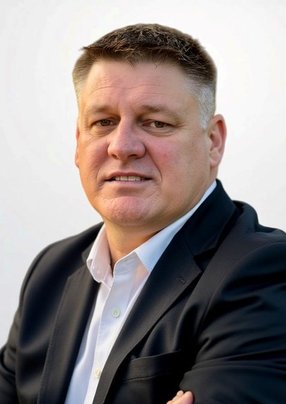
Tony Gill
Senior Director of Operations and Sustainability for ANZ

In healthcare, small margins matter. Gone are the days when delivering the best possible outcomes relied solely on highly skilled clinicians, industry leading research or the most innovative medical devices. Instead, every aspect of the healthcare experience, including the very infrastructure within which patients are treated, needs to be optimised. Even down to details like air quality, natural light volumes, how comfortable the environment is or its energy dependence.
Tony Gill and his colleagues at Northwest Healthcare call this ‘properties that serve a greater purpose’. Their work involves delivering healthcare real estate that looks to be resilient, high-performing and sustainable to enable the best possible health outcomes for the global communities that rely on them.
Tony has spent more than 20 years in building management and technical operations across the retail, commercial, industrial and health sectors. Over this period, he has worked with some of Australia’s leading companies.
Tony joined Northwest Healthcare, which is part of a global healthcare real estate trust, in 2021. In his role as Senior Director of Operations and Sustainability for ANZ, he is responsible for leading the region’s operational performance and delivery of the strategy across the company’s Australian and New Zealand portfolio, which forms part of a broader global portfolio spanning 169 properties in seven countries including Australia, New Zealand, Canada, Germany, Brazil, the Netherlands and the US.
“Our goal is simple, but powerful: to enable better health outcomes by delivering high quality and future-ready healthcare infrastructure,” says Tony. “We focus exclusively on healthcare assets including acute hospitals, mental health centres, medical office buildings, research facilities and specialist clinics. Our ethos is that these aren’t just properties, they’re critical infrastructure that people rely on 24/7.
“To deliver on that, we take a long-term approach,” he adds. “That means investing heavily to ensure our assets aren’t just functional, but aim to be high-performing, resilient and sustainable. Focusing our efforts on building assets to support better patient outcomes is key to our strategy. Whether decarbonising hospitals, upgrading buildings or improving environmental quality, our vision is to create healthcare environments that are safe, efficient and support the wellbeing of patients and professionals.”
Establishing a robust foundation
Sustainability is critical to the modern built environment, a sentiment that Tony has seen evolve over his career. “It’s shifted from a compliance-driven exercise to a strategic business priority, more rapidly post-Covid,” he affirms.
“In healthcare in particular it’s now about resilience, air quality and energy independence – there’s a deeper understanding about how buildings contribute to better health outcomes.”
Tony brought this mindset to Northwest Healthcare in 2021 when, he says, sustainability in the healthcare real estate sector was in its early stages.
On his arrival Tony set about pushing the company’s ambitions even further. “One of my first priorities was building a clear, data-informed energy baseline through data collection, mapping emissions, energy, water and waste across every asset,” he explains. “We followed that with detailed energy audits, which gave us the insight to understand where we stood and, more importantly, where we needed to go.”
From this data, Tony and the team developed tailored carbon reduction roadmaps for the 75 properties in the regional portfolio. This included lighting upgrades, air conditioning optimisation, solar feasibility studies, electrification and equipment lifecycle planning.
“We didn’t just talk about decarbonisation," Tony states, “we mapped it out in detail, property by property to prioritise activities across the regional portfolio. Since, sustainability has been embedded into everything we do, helping us deliver national firsts and earn Global Real Estate Sustainability Benchmark (GRESB) sector leadership.”
To read the full article in the magazine, click HERE.
Company portals
Executives
Tony Gill
Senior Director of Operations and Sustainability