
5 AI Lessons for Building Resilient Healthcare Supply Chains
For years, healthcare supply chains focused on a single goal: keep costs down.
But in today’s unpredictable geopolitical and global health landscape, cost can no longer be the organising principle when a patient’s life is at stake.
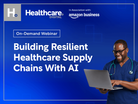
This shift was the central theme of a webinar hosted by Healthcare Digital in partnership with Amazon Business exploring how AI is reshaping supply chain strategy in healthcare, where speakers made the case that resilience must now sit at the centre of decision-making.
During the session, Kenny Otto, Head of Supply Chain at the NHS’s Royal Papworth Hospital and Yari Holzer, Director of Medical Technology Procurement and Investment Planning at University Hospital Tübingen in Germany, discussed how the pandemic and ongoing geopolitical instability have exposed the fragility of cost-optimised supply chains, and why data, transparency and risk mitigation are now essential to keeping care continuous.
If you would like to learn more about how healthcare organisations can build resilience into their supply chains with AI, you can watch the webinar on demand.
Here are five key lessons from the session with Kenny and Yari.
1. Healthcare supply chains must look beyond cost alone
Kenny and Yari started by emphasising that a supply chain approach built purely around minimising cost cannot survive when major disruption hits.
“The lowest price alone cannot be the primary objective anymore,” Yari explains. “We have learnt that resilience and supply chain transparency are equally important.”
They pointed to the pandemic as the clearest lesson in what happens when supply chains are optimised for price alone, with continuity, transparency and the ability to respond quickly all sacrificed in the process.
The takeaway wasn't that cost no longer matters, but that it can no longer be the sole variable. Supply continuity, clear visibility into a product or material’s location and the ability to anticipate risk before it becomes a shortage were all described as equally critical to protecting patient care.
“The lowest price alone cannot be the primary objective anymore. We have learnt that resilience and supply chain transparency are equally important.”
2. Data quality must come first
None of that is possible without accurate, integrated data, and the panel was clear about how far most organisations still have to go on their data journey.
AI can only amplify what's already there, for better or worse. Kenny explains: “It’s garbage in and garbage out – AI is not going to solve your issues if your data is inaccurate.”
Cleansing data and compiling it into a “single source of truth” is a good starting point to ensure healthcare data systems are aligned.
Fragmentation was referenced as a recurring obstacle, often characterised by siloed systems, incomplete last-mile visibility and data spread across departments in ways that make it hard to see the full picture.
Yari put it simply: "Most organisations have enough data, but what they need is integrated data."
3. Learn from major global disruptions
The pandemic, tariffs and ongoing conflict in the Middle East were all referenced as key disruptors to healthcare supply chains.
Recent global disruptions have exposed that many organisations do not have enough information covering complex supply chain dependencies, meaning they “reacted to, rather than anticipated those disruptions,” according to Yari.
Kenny agreed with this point, saying: "Without accurate data, you are always reactive."
The point echoed throughout the discussion: organisations that had invested in AI and data-driven visibility tools before disruption hit were able to respond quickly, while those that had not were left scrambling.
4. AI adoption must have clear guiding principles
The panel was equally clear that AI should enhance human decision-making, not replace it.
Use cases discussed included predictive analytics, supply chain optimisation and better resource positioning ahead of demand spikes.
Kenny and Yari stressed that adoption only works when it's tied to a real business problem, backed by proper governance and supported by staff training and trust-building.
Otherwise, AI risks becoming another tool nobody actually uses.
5. Resilience is an investment
Supply chain resilience and AI integration shouldn't be viewed as costs to be minimised, but as strategic investments in an organisation's ability to keep delivering care.
As one speaker put it during the discussion: "Resilience should not be viewed as an additional cost, but as an investment in continuity of care."
Getting there, Yari and Kenny agreed, starts with reliable data foundations, but does not end there – it also requires organisational culture change and giving teams the skills to work confidently alongside AI-driven tools.

What is Amazon Business?
Amazon Business is a global platform that helps organisations make purchasing easier, control spending and improve supply chain efficiency.
The platform makes complex buying processes simpler and offers tools to help everyday purchases support sustainability goals.
With Guided Buying, administrators can set central rules, highlight preferred items, or block purchases that fail to meet an organisation's ESG standards.
Amazon Business also shows supplier sustainability ratings, like EcoVadis scores, right on the supplier listings when you make a purchase.
To hear the full discussion hosted by Healthcare Digital and Amazon Business on building resilient healthcare supply chains with AI, watch the webinar on demand.
Company portals



Executives
Kenny Otto
Head of Supply Chain Management
Yari Holzer
Director Medical Technology Procurement & Investment Planning