Fujitsu and Nvidia: Harnessing AI to Transform Healthcare
Japan's ageing population crisis has inspired an ambitious partnership between Fujitsu and Nvidia, aimed at revolutionising healthcare delivery through artificial intelligence.
The collaboration centres on developing a healthcare orchestrator platform that coordinates multiple AI agents to streamline administrative tasks, allowing medical professionals to focus on patient care.
With Japan having the world's highest percentage of people over 65, the healthcare system faces mounting pressure on resources and staff.
Fujitsu, generating approximately US$24.64 billion in revenue last fiscal year with a global workforce of 113,000, has identified healthcare AI as a critical growth sector within its broader strategy to address societal challenges.
Orchestrating AI for seamless healthcare integration
The platform's distinguishing feature lies in its ability to coordinate numerous AI systems simultaneously without replacing existing infrastructure.
Rather than forcing healthcare institutions to overhaul their current systems, Fujitsu's orchestrator integrates with various AI agents tailored for specific medical roles – from standardising patient data to ensuring systems communicate effectively.

This orchestrator AI agent functions like a conductor managing multiple specialised healthcare programmes, with each AI-driven agent operating as an autonomous software component capable of executing distinct tasks independently.
The system operates predominantly autonomously, enabling integration of diverse medical applications without manual coordination.
Nvidia contributes essential infrastructure through its NIM microservices – pre-configured AI tools ready for quick deployment – and reference designs called Blueprints, which provide the foundation for rapid implementation.
Enhancing productivity through administrative automation
The primary objective for healthcare providers is allocating AI for administrative burdens, freeing up medical professionals to prioritise direct patient care.
Healthcare managers could reallocate staff from paperwork to clinical duties, potentially enhancing revenue and job satisfaction.
For patients, this transformation translates to reduced waiting times and improved individualised care tailored to their needs.
The effectiveness of this technology remains to be fully realised in practical settings, but Fujitsu plans to partner with global medical institutions to evaluate its capabilities next year.
The pilot programmes will provide data on the platform's real-world performance in complex healthcare environments, where regulatory compliance and patient safety remain priorities.
Building a marketplace for specialised AI tools
Fujitsu's approach allows integration with AI agents from other firms, effectively creating a marketplace where various providers can contribute specialised tools to the ecosystem.
This open architecture could appeal to healthcare institutions often cautious about wholesale technology changes that might disrupt established workflows.
Gradual AI adoption without completely overhauling current systems might make the transition more palatable for conservative healthcare organisations.
The platform's flexibility allows institutions to select and implement specific AI agents based on their unique operational requirements, rather than adopting a one-size-fits-all solution.
This modular approach acknowledges the diverse needs across different healthcare settings, from large hospital systems to smaller specialist clinics.
Expanding beyond healthcare: full-stack AI infrastructure
While healthcare represents a primary focus, the expanded strategic collaboration between Fujitsu and Nvidia extends beyond medical applications.
The partnership aims to create full-stack AI infrastructure integrating AI agents across multiple sectors, including manufacturing and robotics.
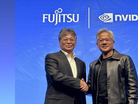
Takahito Tokita, Fujitsu's representative director and CEO, says: “Fujitsu’s strategic collaboration with Nvidia will accelerate AI-driven business transformation in enterprise and government sectors.
“By combining the cutting-edge technologies of both companies, we will develop and provide full-stack AI infrastructure, starting with sectors such as manufacturing where Japan is a global leader.
“To further support the expanding needs of AI infrastructure, Fujitsu and Nvidia will expand this partnership in the areas of high-performance computing and quantum."
The initiative focuses on co-developing an AI agent platform tailored for industry-specific applications, coupled with computing infrastructure that integrates the FUJITSU-MONAKA CPU series and Nvidia GPUs via Nvidia NVLink Fusion.
Leveraging cutting-edge computing power
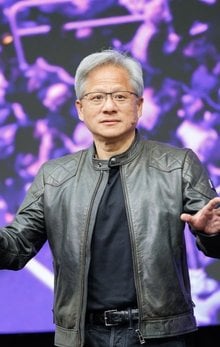
Jensen Huang, Nvidia's Founder and CEO, positions the collaboration within the broader context of building infrastructure to power the AI industrial revolution globally.
He says: “The AI industrial revolution has begun and we must build the infrastructure to power it – in Japan and across the globe.
“Fujitsu is a true pioneer in computing and Japan’s trusted leader in supercomputing, quantum research and enterprise systems.
“Together, Nvidia and Fujitsu are connecting and extending our ecosystems to forge a powerful partnership for the era of AI.”
Nvidia's chips are crucial for powering large language models and AI systems used commercially, making the partnership logical in an increasingly crowded healthcare AI market.
Addressing Japan's demographic challenges
The initiative arises as Japan's healthcare system confronts the challenges of an ageing population, with significant implications for resource allocation and workforce availability.
This demographic reality drives Fujitsu's wider Uvance strategy, focused on leveraging technology to address pressing societal challenges.
The company aims to establish this AI infrastructure as an indispensable social foundation for Japan's digital society by 2030, accelerating enterprise AI market growth while fostering corporate development and creating substantial social value.
As healthcare providers globally face staffing deficiencies, automation becomes increasingly attractive for routine tasks not requiring human discernment.
The vision encompasses a human-AI co-creation cycle where high-speed AI computing integrates with human judgement and creativity.
Manufacturing and robotics transformation
Beyond healthcare, the collaboration targets manufacturing sectors where Japan is among global leaders.
The platform will accelerate manufacturing using digital twins and leverage physical AI, including robotics for operational automation to address labour shortages.
The companies plan to develop an AI agent platform that balances high speed with strong security through multi-tenancy support, built on Fujitsu Kozuchi and integrating Fujitsu's AI workload orchestrator technology with the Nvidia Dynamo platform.
Competitive landscape and execution challenges
The healthcare AI market is competitive, comprising established medical software entities and AI-focused startups, each vying for market dominance.
The critical factor lies in execution and the platform's performance within practical healthcare settings.
Whether Fujitsu and Nvidia can deliver on the promise of seamless AI coordination in one of the most complex and regulated industries globally remains to be seen.
If AI agents adequately handle administrative duties, medical professionals can focus on patient care, presenting a potentially transformative scenario for healthcare delivery.


Executives
Jensen Huang
Founder and CEO