
How Will Trump Tariffs Impact EU Healthcare Exports?
The trade agreement between the European Union and the United States is already forcing healthcare and life sciences companies in Europe to rethink their export strategies.
At the heart of the pact lies a 15% tariff on most EU goods entering the US, including pharmaceutical products, which remain Europe’s top export category to the American market.
This is reshaping global supply chains and posing immediate financial and operational challenges for healthcare manufacturers across the continent.
Pharmaceutical exports, including generic drugs and biotechnology products, now face fresh price pressures and logistical upheaval as they are pulled into the wider economic and political aims of the deal.
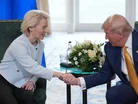
European Commission President Ursula von der Leyen and US President Donald Trump unveiled the terms following talks in Scotland, presenting the pact as a way to stabilise trade relations, though European industries have been quick to highlight the costs.

Healthcare exports hit by 15% tariff
Healthcare sits at the core of the sectors hardest hit by the new agreement.
While some exports, such as aircraft components and selected raw materials, are exempt from the new 15% tariff, pharmaceuticals are not.
That means life sciences companies exporting drugs, treatments and other health-related products to the United States are now dealing with an additional 15% cost on every shipment.
This tariff level, down from a previously threatened 30%, still marks a sharp increase from pre-2024 rates.
It changes both the pricing structure and the logistics behind much of Europe’s healthcare trade.
With pharmaceuticals making up the EU’s largest category of goods exported to the US, the new costs reverberate across the entire life sciences supply chain, from R&D and manufacturing through to distribution.
Brussels has agreed to commit US$750bn in purchases of American energy, nuclear fuel and semiconductors over a three-year span.
It will also channel US$600bn into US industries, including defence.
These commitments are seen as part of a broader exchange to secure lower tariffs than initially proposed.
Yet no direct protection was offered to the healthcare sector in return.
While some sectors, such as semiconductor equipment and certain chemicals, escape the tariff altogether, healthcare companies face not only the added cost but also the risk of a longer-term trade imbalance.
European firms reliant on US-bound exports may need to alter supply chains or absorb reduced margins.
Supply chain disruptions across sectors
Outside of healthcare, the trade deal introduces wide-reaching supply chain changes.
The automotive industry in Germany is also facing the 15% tariff, leading firms like Volkswagen to announce a €1.3bn (US$1.5bn) drop in first-half profits.
The company attributes the shortfall directly to the new tariff regime.
Germany’s broader industrial base, especially export-heavy manufacturers, remains under pressure.
Prashant Newnaha, Senior Asia-Pacific Rates Strategist at TD Securities, remarks: “A 15% tariff on European goods, forced purchases of US energy and military equipment and zero tariff retaliation by Europe, that’s not negotiation, that’s art of the deal.”
Wolfgang Niedermark of the German industrial federation BDI, adds: “Even a 15% tariff rate will have immense negative effects on export-oriented German industry.”
The chemical industry has echoed the same concern. Trade group VCI refers to the tariff level as "too high."
In contrast, American exporters are seeing reduced barriers.
The EU has agreed to recognise US vehicle standards, which simplifies the process for American carmakers to enter European markets.
The deal also opens more space for US agricultural goods, another area where European producers face stiffer competition.
For steel and aluminium, however, there is no change.
These goods remain subject to 50% tariffs, and although quota-based solutions are under discussion, no adjustments have been announced.
Niche goods such as wine and spirits also await classification decisions, leaving exporters without clarity on future trade terms.
Political unease and uncertain outcomes
The fallout from the agreement goes beyond trade logistics and touches national politics across the EU.
One visible flashpoint is Ireland. Irish firms now face the full 15% US tariff, while companies based in Northern Ireland, still governed by the UK-US trade arrangement, pay just 10%.
This disparity has reignited Brexit-era tensions, especially around the Good Friday Agreement and border trade rules.
Political leaders across the bloc have responded differently.
Political reactions vary. French Prime Minister Francois Bayrou calls the outcome bleak, stating: “It is a sombre day when an alliance of free peoples, brought together to affirm their common values and defend their interests, gives in to submission.”
Meanwhile, Italy’s Giorgia Meloni takes a cautious line, labelling the new tariff “sustainable,” though she notes she is waiting for “details.”
The US government expects to collect roughly US$90bn annually through the new tariffs.
For EU leaders, the deal is being presented as a necessary compromise to avoid a deeper trade war.
Yet critics argue that the health and industrial sectors are being sacrificed to achieve this outcome.
Analysts at the European Central Bank say trade conditions are now "exceptionally uncertain," and note that long-term planning across industries will become more difficult.
For the life sciences and healthcare sectors, which rely on stable global supply chains and predictable regulation, these trade terms create more volatility and less room for strategic forecasting.