
Inside AstraZeneca’s US$1bn Tech-Integrated R&D Centre

As part of AstraZeneca’s strategy to reach US$80bn in total revenue by 2030, the company is investing in its US footprint, where it expects to generate 50% of this revenue.
Following a US$50bn commitment to its US-based manufacturing and R&D operations up until 2030 announced in July 2025, the company has now unveiled a state-of-the-art strategic R&D centre in Kendall Square, Cambridge, Massachusetts.
Spanning 570,000 sq ft and rising 18 storeys high, including 10 floors of interlinked laboratory space designed to facilitate collaboration, the facility is the product of a US$1bn investment and deepens AstraZeneca’s connection to a pivotal life science ecosystem.
Addressing the centre’s opening on LinkedIn, Pamela Hill, Head of Open Innovation Programme at AstraZeneca, writes: “As part of our global network of strategic R&D centres, this investment will help accelerate the discovery and development of the next generation of medicines for patients.”
AstraZeneca operates three R&D organisations focusing on biopharmaceuticals, oncology and rare diseases. The Cambridge, Massachusetts centre will combine all three as it develops AstraZeneca’s research into COPD, metabolic disease and breast cancer.
The company is striving to launch at least 20 new molecular entities (NMEs) to support its 2030 revenue ambition. An innovative, well-funded approach to R&D – one which leverages the company’s global network – makes up a key component of its overall growth strategy.
A tech-integrated laboratory at scale
“Kendall Square is a leading innovation ecosystem, and it is one of the key locations where AstraZeneca will discover the next generation of scientific breakthroughs,” says Pascal Soriot, CEO at AstraZeneca.
The spatial design of its Kendall Square centre has been specifically executed to enable collaborative R&D work, in order to drive innovation and maintain the flow of information across the high-capacity research space.
Open-plan laboratories will link workspaces together, fostering a fluid exchange of information between the nearly 2,000 researchers set to occupy the centre.
Integrating AI and robotics to drive data-enhanced drug discovery has been a key direction for AstraZeneca: the company reports that over 90% of its small-molecule discovery pipeline is AI-enabled. Its worldwide R&D organisation is supported by over 600 data science specialists.
The Kendall Square centre will therefore embed advanced technology directly into its research workflows, with operations supported by continuous lab automation and agentic AI.
A blueprint for the centre’s technological integration lies in AstraZeneca’s iLab, a smaller-scale R&D facility located in Gothenburg, Sweden.
Described by AstraZeneca as its prototypical model of a fully-automated laboratory, the iLab harnesses the company’s Molecular AI platform to:
- Use AI analysis for design identification.
- Automatically synthesise small molecular compounds.
- Purify synthesised compounds into solutions ready for screening.
- Test compounds with nanoSAR, an accelerated testing technology.
- Harvest data on testing performance.
The iLab brings a significant speed and productivity boost to the drug discovery process and aims to achieve full design-make-test-analyse cycle (DMTA) autonomy.
At Kendall Square, the company has the opportunity to apply this optimised model on a larger scale within a global hub of life science innovation.
- Located in Cambridge, Massachusetts, near the state capital, Boston, Kendall Square has been described as “the most innovative square mile on the planet.”
- The neighbourhood has provided an operational hub for a cluster of over 120 biotechnology and pharmaceutical companies since the 1990s.
- It sits directly adjacent to the Massachusetts Institute of Technology and in close proximity to Harvard University.
- It hosts significant research institutions, including the Broad Institute, the Koch Institute and the Ragon Institute.
- Alongside its strategic R&D centre, AstraZeneca operates a research facility for genomic medicine within the neighbourhood.
Kendall Square: a strategic position
The company has five major strategic R&D centres across the world, including campuses in the UK and China.
Its Kendall Square site will allow it to consolidate its footprint in the US, giving it close access to one of its biggest commercial markets. As the company continues to invest in its American research and manufacturing capabilities, proximity to domestic supply chains will be crucial.
“The United States brings together outstanding universities, brilliant scientists, ambitious entrepreneurs and capital at a scale that is difficult to replicate anywhere else,” says Rick Suarez, President of AstraZeneca US.
“Kendall Square is a great example of what happens when all of those things come together around science and the opportunity to improve patients’ lives.”
Kendall Square brings AstraZeneca close to the facilities of pharmaceutical partners like Merck & Co., alongside nationally significant universities and research institutes. Leading hospitals such as Mass General Brigham and Women’s Hospital are also located in nearby Boston.
AstraZeneca – key partners
Merck & Co.
CEO: Robert M. Davis | HQ: Rahway, New Jersey
Merck & Co. is a global pharmaceutical company with an R&D presence in Cambridge, Massachusetts focused on early-stage discovery research. Its strategic relationship with AstraZeneca dates to 2017, when the companies established a major oncology collaboration combining AstraZeneca's PARP and MEK inhibitors with Merck's Keytruda. The partnership has helped advance combination approaches in cancer and demonstrates the role of external collaboration in AstraZeneca's R&D strategy.
Owkin
CEO: Thomas Clozel | HQ: Paris, France
Owkin develops AI systems for biomedical research and works with AstraZeneca under a multi-year agreement involving AI agents and its K Pro platform. The programme is designed to integrate specialised biological agents into AstraZeneca's workflows, demonstrating how external AI expertise can be embedded directly into enterprise R&D decision-making rather than remaining a standalone research tool.
Tempus
CEO: Eric Lefkofsky | HQ: Chicago, US
Tempus is a healthcare technology company specialising in clinical and molecular data. AstraZeneca is collaborating with Tempus, alongside Pathos AI, in a US$200m multi-year expanded partnership to develop a large oncology foundation model, with applications including clinical-trial matching and study design. The partnership marks one of AstraZeneca’s major R&D projects.
Company portals

Executives

Pamela Hill
Senior Director, Global Head of Open Innovation
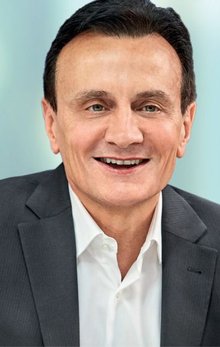
Pascal Soriot
CEO
Rick R. Suárez
US President and SVP US BioPharmaceuticals Business Unit