
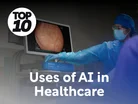
AI is being increasingly adopted in the healthcare sector, with uses in pharmaceuticals, research and hospital settings.
It can be used to automate tasks and cut down on time and cost, freeing up healthcare professionals to take on more complex tasks.
Many companies are making innovations in this area, developing new AI platforms and systems to help build a future-proof healthcare industry, including making processes more resilient and effective.
Healthcare Digital explores the top uses of AI in the healthcare industry, from patient triage and administrative tasks to its use in surgical environments.
10. Predictive analytics for resource and capacity management
Company in focus: GE Healthcare
HQ: Illinois, US
CEO: Peter J. Arduini
Predictive AI models can forecast the influx of patients, staffing needs and bed availability in a hospital.
GE Healthcare provides "Command Centre" solutions that use predictive AI to optimise patient flow.
These have helped hospitals assign emergency department patients to beds up to 38% faster.
9. Digital pathology
Company in focus: Philips
HQ: Amsterdam, Netherlands
CEO: Roy Jakobs

Philips's digital pathology platform facilitates real-time collaboration between clinicians, using AI-enabled diagnostics to improve patient safety and outcomes.
This tool uses AI to analyse tissue slides at a microscopic level, assisting in cancer grading and identifying biomarkers for therapy.
It is an essential component of the precision medicine pipeline, providing a foundation for many oncology treatments throughout the pharmaceutical and healthcare sector.
8. Conversational AI for mental health
Company in focus: UnitedHealth Group
HQ: Minnesota, US
CEO: Stephen J. Hemsley

Conversational AI can be used to address the systemic shortage of qualified therapists, helping to tackle the growing issue of mental health.
Mental health AI can provide accessible support through chatbots that have been trained with clinical techniques like Cognitive Behavioural Therapy (CBT).
UnitedHealth Group uses AI through its Optum division to enhance patient engagement and behavioural health support.
It deploys scalable AI solutions to manage common questions and guide patients toward appropriate mental health resources.
7. Patient triage
Company in focus: Epic Systems
HQ: Wisconsin, US
CEO: Judy Faulkner

Patient triage systems are the first point of contact, used to direct patients to the appropriate level of care.
Epic Systems provides AI-powered patient triage and engagement tools embedded into patient portals.
This allows for automated responses to messages, as well as real-time routing of contact centre calls.
This implementation of AI helps to reduce overcrowding in emergency departments and ensures that resources are allocated to the most critical cases first.
6. Precision medicine
Company in focus: NVIDIA
HQ: California, US
CEO: Jensen Huang
Precision medicine uses AI to synthesise data points, including genomic sequencing and molecular profiling.
These can be used to create personalised treatment plans for patients.
This is particularly useful in oncology, where the effectiveness of a therapy depends on the specific genetic mutations of a tumor.
NVIDIA's technology works as foundational infrastructure for precision medicine, partnering with institutions including Mayo Clinic to build digital pathology platforms and accelerate biomarker discovery.
5. Clinical trial optimisation
Company in focus: IQVIA
HQ: North Carolina, US
CEO: Ari Bousbib
The development of new therapies can often be delayed by poor patient recruitment and site selection.
AI platforms can analyse electronic health record (EHR) data and genetic markers to identify eligible patients quickly, accelerating clinical trial timelines.
IQVIA specialises in advanced analytics for the life sciences sector, using AI to automate patient identification and site selection.
Ari Bousbib, Chairman and CEO of IQVIA, says: "With IQVIA's unique capabilities to innovate, accelerate trial delivery and facilitate industry-wide collaboration, I am confident we will continue to make a significant and meaningful impact on global health and advance our mission."
4. Robotic-assisted surgery
Company in focus: Intuitive Surgical
HQ: California, US
CEO: David J. Rosa
Intuitive Surgical's da Vinci Surgical System has been used in more than 20 million procedures to date.
The robot-assisted surgery system incorporates AI to personalise surgeon training and provide real-time image enhancement.
Robotic surgery has evolved into an intelligent assistant that provides real-time guidance and safety checks to help surgeons.
AI-enhanced robotics can be used to filter out hand tremors and map out optimal surgical pathways based on pre-operative scans.
3. Clinical decision support
Company in focus: Oracle
HQ: Texas, US
CEO: Clay Magouyrk & Mike Sicilia

Oracle has embedded AI agents directly into the Cerner EHR to streamline clinical workflows.
These tools are used to provide evidence-based support at the point of care, which helps physicians navigate complex clinical literature and treatment guidelines.
Clinical decision support tools are powered by LLMs to provide real-time, cited answers to complex clinical questions, acting as a high-fidelity knowledge layer to help clinicians and medical professionals across the healthcare sector.
2. Drug discovery
Company in focus: Alphabet
HQ: California, US
CEO: Sundar Pichai

Drug discovery has high transformative economic potential and an ability to solve fundamental biological challenges.
The traditional pharmaceutical pipeline can take nearly a decade of research and more than one billion dollars to create a new drug.
AI can help shorten this process by identifying novel therapeutic targets.
Alphabet's DeepMind division has created AlphaFold, which predicts protein structures with a high level of accuracy.
Google Health uses this potential to accelerate drug development and disease research, which can outpeform human experts in diagnostic benchmarks.
1. Medical imaging
Company in focus: Medtronic
HQ: Dublin, Ireland
CEO: Geoff Martha

Medical imaging has immediate life-saving potential and a high level of regulatory maturity.
More than 75% of FDA-authorised AI devices come from the radiology and imaging sectors.
The primary mechanism used in medical imaging involves deep learning algorithms that scan imaging data as it is acquired, identifying anomalies before a human specialist review.
Medtronic has integrated AI across multiple imaging specialties.
Its GI Genius system was the first FDA-cleared AI endoscopy module, using computer vision for real-time colorectal polyp detection.
Based on its current global install base, it has the potential to impact almost three million patients annually.
The system has the ability to automate physicians' workflow, reduce administrative burdens in documentation and set up for future integration with electronic health records.
Company portals








Executives

Ari Bousbib
CEO

Dave Rosa
President
Geoff Martha
CEO and Chairman Of The Board Of Directors
Jensen Huang
Founder and CEO

Judy Faulkner
CEO

Mike Sicilia
Chief Executive Officer
Peter J Arduini
President & CEO
Roy Jakobs
CEO

Stephen J. Hemsley
CEO
Sundar Pichai
CEO