COP30: A Lack of Cooling Systems Will Lead to Health Crisis

A landmark report from the United Nations Environment Programme (UNEP) launched at COP30 has highlighted the critical link between sustainable cooling and climate action with major implications for the healthcare sector.
The Global Cooling Watch report finds that without a major change in how buildings are cooled and heated, halting climate change may be impossible.
For healthcare providers, this presents a dual challenge: ensuring patient safety in the face of extreme heat while managing the sector's substantial energy consumption.
Regulating the temperature of buildings is a major contributor to global energy use. According to the International Energy Agency (IEA), space heating contributes to 40% of all energy-related CO₂ emissions.
This new report from the UNEP finds that cooling systems alone account for 20% of all global electricity consumption.
For hospitals, clinics and medical storage facilities that require constant and reliable temperature control, this energy demand is non-negotiable. As global temperatures continue to rise, this need will only intensify.
Rising temperatures and patient health
The demand for cooling is growing rapidly. “Installed cooling capacity is on a trajectory to triple by 2050, potentially increasing emissions to 7.2 billion tonnes of carbon dioxide equivalent even with efficiency gains and refrigerant phase-down efforts,” reads the foreword by Winston Chow Lee Kong Chian Professor of Urban Climate and Martin Krause Director for Climate Change at UNEP.
While much of this growth is in the residential sector, its impact on public health is direct. The report notes that cooling is becoming “utterly necessary for human survival”.
However, it also projects that despite a rise in demand for air conditioning, almost half the world’s population will lack access to these systems by 2050. This creates a health equity issue where vulnerable populations, including those with chronic illnesses, may be unable to protect themselves from heat-related health risks.
The report suggests that under a business-as-usual pathway, “cooling emissions to 7.2 billion tonnes of CO₂e” could be reached despite existing efficiency policies.
Sustainable cooling for healthcare infrastructure
The central message for the healthcare industry is that conventional air conditioning is not a long-term solution.
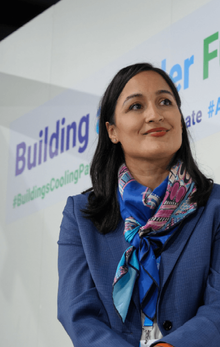
“Current trends demonstrate that societies cannot simply air condition their way out of escalating heat risks,” says Lily Riahi, UNEP Cool Coalition Project Lead.
She adds: “Instead, adaptation and mitigation must be addressed together with systemic approaches [...] integrating passive and active cooling solutions at the national and subnational levels.”
For healthcare facilities, this means prioritising passive design in new builds and retrofits. Measures such as building orientation, external shading, insulation and natural ventilation can offer comfort more sustainably than energy-intensive mechanical systems.
The report’s modelling finds that these measures “can achieve average temperature reductions of 2.2 degrees Celsius and energy savings of 29%”. These strategies are identified as the “most equitable and cost-effective options”.
Hybrid solutions like combining fans with air conditioning are also noted as effective.
“Energy-saving hybrid approaches can cut energy use by more than 30% compared to conventional air conditioning, providing affordable and sustainable comfort solutions,” the report says.
Cooling the digital health revolution
The report also highlights the “rising demand from digital infrastructure – most notably data centres that require continuous high-efficiency thermal regulation”.
This is particularly relevant to healthcare’s digital transformation, which relies on data centres to run electronic health records, telemedicine platforms and AI diagnostic tools. Traditionally, these facilities have used air-based cooling, but a move towards liquid and hybrid systems can “cut cooling energy use by 20 to 50%”.

A UK-based case study shows that “optimising operations [...]could cut data centre cooling demand by 16% while widespread liquid cooling adoption could lower it by 42% versus business-as-usual”.
This change could also slash direct refrigerant emissions. As healthcare becomes more data-reliant, ensuring the sustainability of its digital backbone is essential.
The Global Cooling Pledge launched at COP28 now unites 72 countries in an effort to cut cooling-related emissions by 68% by 2050.
However, the UNEP report is clear that implementation gaps in building energy codes remain a major hurdle. For experts like Lily, the path forward is clear.
“By making sustainable cooling the foundation of heat resilience, we can protect lives and livelihoods today while preserving the places, traditions and futures we hold dear," she says.
Company portals

Executives
Lily Riahi
Head of the UNEP Cool Coalition Secretariat