Waters: Integrating Anthropic AI Into Laboratory Workflows
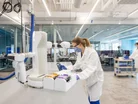
Global life sciences and diagnostics leader Waters Corporation is aiming to connect AI directly to its laboratory instruments, enabling pharmaceutical researchers to move from AI-generated hypotheses to physical experiments with less manual intervention.
Central to this goal is the company's launch of Waters AI Link, a software capability that brings Anthropic’s Model Context Protocol (MCP) to its waters_connect informatics platform.
The integration allows scientists to use natural language to direct Waters instruments and manage laboratory workflows through AI models and agents, including Anthropic’s Claude and Claude Science.
AI Link supports tasks such as creating methods, running acquisitions and processing results, while coordinating connected equipment such as sample preparation systems.

Waters’ announcement is the latest example of a wider industry shift, as automated, AI-powered research environments increasingly blur the lines between computational research and physical experimentation.
Danaher has announced it is developing an AI-powered autonomous lab and formed a partnership with NVIDIA, while Roche is advancing AI-driven research through its own lab-in-the-loop strategy.
Closing the loop
The aim is to help laboratories close the loop between computational research and physical experimentation. As AI models generate hypotheses at increasing speed, researchers face growing pressure to test them efficiently.
By automating steps between experiment design, instrument operation and data analysis, AI-enabled workflows help teams investigate more possibilities, reduce manual hand-offs and accelerate research and development.
“We’re not asking anyone to rebuild their lab. We’re bringing AI to the tools they already trust and use. ”
Waters is also joining Anthropic’s Model Hardware Standard (MHS) research programme, which aims to make it easier for AI agents to operate physical laboratory equipment safely and autonomously.
The standard is designed to reduce the time required to integrate instruments, potentially cutting a process that can take weeks or months to hours or minutes.
A key consideration is how these workflows can extend beyond research into regulated pharmaceutical development and quality control.
Waters says its informatics platforms provide a route for work to progress from waters_connect into its Empower software, which supports regulated laboratory environments, while maintaining the data integrity and traceability required as molecules advance towards release.
AI Link is available now through an early-access programme, with general availability for waters_connect customers planned for November 2026.
Dave Leitham, Vice President of Informatics at Waters Corporation, shared insights with Healthcare Digital on the laboratory tasks most likely to benefit from AI integration, how automated experimentation could reshape pharmaceutical research, and the importance of maintaining trust, accountability and compliance as AI moves into regulated settings.
What specific laboratory tasks or workflows do you expect to benefit most from Waters AI Link, and how will scientists and researchers be able to measure the resulting efficiency gains?
DL: The biggest gains are in the work around the run: building sample lists, setting up methods, assigning instruments, submitting work, and pulling results and reports. Today that means a lot of clicking and hand-offs.
With AI Link, a scientist describes what they want in plain language, and it becomes a defined action in waters_connect software. It also means newer analysts get up to speed faster, and labs rely less on a few power users. And because AI Link can orchestrate connected devices like sample prep systems, the steps work together instead of in silos.
To measure it, use your own lab as the baseline. Track time from sample to reviewed result, instrument utilisation, manual touchpoints and repeat analyses, and cost per result, before and after.
I wouldn’t promise one number for everyone, but in development settings we expect timelines to come down from weeks to days.
How could AI-enabled, automated laboratory workflows change the speed and scale of pharmaceutical research?
DL: AI can now come up with ideas faster than any lab can test them, so the bottleneck has moved to the bench. Every hypothesis a model generates becomes a real sample that someone has to separate and measure.
What gets me excited is closing that loop. The AI suggests an experiment, the instrument runs it, and the result goes right back to the model, which uses it to design the next one. Every result makes the next experiment smarter. Teams waste fewer cycles, and they can explore a lot more ground.
That’s where AI Link comes in. It connects AI agents to the data and instruments through waters_connect Software, so scientists aren’t hand-carrying every step from one system to the next. As labs move in that direction, we expect experiments to run more continuously and to scale without adding people at the same pace.
The big win for scientists is time. Less of it goes to shuffling work around, and more goes to the part only people can do: deciding what to ask next and making sense of the surprises.
“The big win for scientists is time. Less of it goes to shuffling work around, and more goes to the part only people can do. ”
What are the biggest challenges in taking AI-directed experiments from research into regulated development and quality control?
DL: It comes down to trust. In research, a little variability is part of exploring. In regulated development and QC, you have to show exactly what happened, who did it, and that you’d get the same result again. That means data integrity, traceability, validation and clear accountability.
Regulators are still working out their expectations for AI too, so labs want an approach they can document and defend.
That’s why how you bring AI in matters as much as what it can do. With AI Link, we use the Model Context Protocol, an open standard, to package what Waters knows about our software and data, so customers don’t have to worry about those details.
A scientist can just ask for what they need, and the expertise is already built in. That gives labs the flexibility and power to change how they work and to bring that expertise into their broader workflows. And since it all runs through waters_connect Software, people can still only do what they’re already authorized to do.
And different customers will need different things. Many of our customers in research and development will work in waters_connect, and AI Link is built for them. Our QA/QC customers, where Empower is the market leader, have their own regulated requirements and we’re developing AI solutions for them in Empower too.
We’re not asking anyone to rebuild their lab. We’re bringing AI to the tools they already trust and use.
Waters: key partners
Anthropic
CEO: Dario Amodei | HQ: San Francisco, California
Anthropic is an AI research company developing the Claude family of AI models. Its collaboration with Waters brings the Model Context Protocol (MCP) to laboratory informatics and involves Waters in Anthropic’s Model Hardware Standard research programme. The partnership aims to help AI agents interact directly with analytical instruments, supporting automated experimentation and more connected research workflows.
LabWare
CEO: Vance Kershner | HQ: Wilmington, Delaware
LabWare develops laboratory information management systems (LIMS) and electronic laboratory notebooks (ELN). Its long-standing collaboration with Waters integrates LabWare’s informatics tools with Waters’ Empower Chromatography Data System, enabling laboratories to transfer sample worklists and analytical results between systems. The integration helps reduce manual data entry, support data integrity and improve workflows in pharmaceutical research and regulated testing environments.


Executives
David Leitham
Vice President & General Manager, Informatics