GE, Danaher, Fresenius, Enhertu: This Week in Healthcare


GE HealthCare has appointed Rodolphe Katra as its new Global Chief AI Officer, as the medical technology company looks to expand its use of AI across devices, software and healthcare data.
Rodolphe joins from Medtronic, where he served as Chief AI Officer for the past three years.
Following in the footsteps of GE HealthCare’s former AI chief Parminder Bhatia, who left the company in July 2026, Rodolphe will report to Global Chief Science and Technology Officer Taha Kass-Hout.
The appointment comes as GE HealthCare seeks to build on a sizeable portfolio of AI-enabled medical devices. According to CEO Peter Arduini, the company has 134 AI-enabled medical devices authorised for medical use by the US Food and Drug Administration (FDA) – more than any other medtech company.
Welcoming Rodolphe to the role on LinkedIn, Peter writes: “Working closely with our segment teams, Rodolphe will help us take our AI strategy to the next level – connecting devices, software and data to deliver better insights, more longitudinal understanding and more precise care.”
“At GE HealthCare, our goal is simple: build AI-enabled solutions that are making a difference for patients, clinicians and health systems. That’s how we deliver growth and long-term value,” he adds.
Life sciences and diagnostics company Danaher has announced changes to its strategy leadership team as it prepares for a broader transition at the top of the business.
Effective 1 October 2026, Shashanka Muppaneni will become SVP and Chief Strategy Officer, moving from his current role as Group Vice President of Strategy and Business Development for Danaher’s Diagnostics platform.
The appointment comes as Julie Sawyer Montgomery prepares to take over as Danaher’s President and CEO on the same date. Julie, who has led the company’s Diagnostics platform, has played a key role in its growth, with the business increasing from approximately US$6bn in revenue in 2017 to around US$11bn in 2025.
Julie says Shashanka “pairs sharp strategic thinking with a pragmatic, results-oriented approach,” adding that he has demonstrated an ability to align strategy with business execution, deliver strategic M&A and build partnerships across Danaher’s businesses.
“He will be a strong partner as we accelerate Danaher’s strategy and M&A agenda in the years ahead,” she says.
Danaher generated US$24.6bn in revenue in 2025 and operates across biotechnology, diagnostics and life sciences. Its portfolio includes businesses such as Cytiva, Beckman Coulter, Cepheid, Leica Biosystems and Masimo, spanning drug development, biomanufacturing, diagnostics and patient monitoring.
Developed in collaboration between AstraZeneca and Daiichi Sankyo, Enhertu is an antibody-drug conjugate (ADC) used to treat certain patients with HER2-low, unresectable or metastatic breast cancer.
It has now received a recommendation from the EU’s Committee for Medicinal Products for Human Use (CHMP) for use in certain patients with HER2-positive early breast cancer, while the UK's National Institute for Health and Care Excellence (NICE) has recommended the treatment with managed access for adults with unresectable or metastatic HER2-Low breast cancer whose disease has progressed following treatment.
Enhertu uses targeted ADCs to locally deliver chemotherapeutic agents to cancer cells. It has been demonstrated to extend patient lifespans by an average of seven months.
“Patients with HER2-positive early breast cancer who have residual disease after neoadjuvant treatment experience a substantially higher risk of recurrence, making effective adjuvant treatment especially important,” says John Tsai, Global Head of R&D at Daiichi Sankyo.
“This positive CHMP opinion underscores the potential role of Enhertu in the curative-intent setting where it is critical to maximise the potential for sustained long-term outcomes.”
From summer 2027, the UK is expected to have an innovative first within its national health infrastructure: a net-zero emissions dialysis centre.
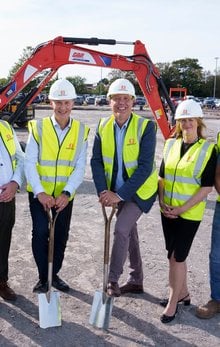
Construction has started on the purpose-built 27-station centre at Aintree University Hospital in Liverpool as Fresenius Medical Care and NHS University Hospitals of Liverpool Group collaborate to make the UK’s first net-zero dialysis facility a reality.
With capacity for 160 patients, the centre will replace the current Aintree clinic and Waterloo unit, increasing capacity by approximately 42%.
The initiative also addresses a pressing national challenge: modernising the UK’s medical facilities to ensure essential treatment can be delivered in an environmentally-friendly manner.
Dialysis is a regular medical treatment that filters waste, removes extra fluid and balances chemicals in the blood when the kidneys fail. As a highly resource- and energy-intensive treatment, dialysis provides an important testing ground for reducing the environmental impact of healthcare.
Commenting on the centre, Jonathon Lawrence, Managing Director UK & Ireland at Fresenius Medical Care, which is a global leader in renal care and dialysis technology, says: “Dialysis is essential. Reducing the environmental impact of the buildings that support it must be a priority too. This centre puts lower-carbon design at the heart of kidney care infrastructure.
“We are always striving to improve the care we provide to patients and, where possible, reduce our environmental impact. This centre is a great example of that in practice, and we hope it can show what is possible for renal care across the UK.”
The longevity market is built around a simple proposition: extend people’s healthy years and delay the onset of ill health, allowing people to live longer with better physical and cognitive wellbeing.
In other words, the focus is on extending healthspan, not simply lifespan.
However, a new study from international consultancy Boston Consulting Group (BCG), conducted for the St Moritz Longevity Forum, suggests the longevity market is failing to adequately serve one of its most engaged customer groups: women going through perimenopause and menopause.
Despite being among the most active users of longevity interventions, these women are also among the least satisfied with the solutions available to them. BCG estimates that closing this gap could unlock a US$350bn opportunity.
Trish Stroman, Managing Director and Senior Partner at BCG and co-author of the study, argues that the industry needs to move beyond the current proliferation of wellness interventions towards solutions supported by clinical evidence.
“BCG's latest consumer study shows women in menopause try ~50% more health interventions than men or younger women. Yet they're still not satisfied with the results,” she writes on LinkedIn.
“They're also willing to pay more — a median of $108/month — for solutions that actually work.
“What would earn that spending? Evidence, not hype. Solutions backed by clinical research and recommended by a doctor or health-care provider.”






Executives

John Tsai, MD
Executive Vice President, Head of R&D
Jonathon Lawrence
Managing Director UK & Ireland at Fresenius
Julie Sawyer Montgomery
CEO
Peter J Arduini
President & CEO
Rodolphe Katra, PhD, MBA
Global Chief AI Officer
Shashanka Muppaneni
Chief Strategy Officer
Trish Stroman
Managing Director and Senior Partner