
Supply Chain LIVE: How Novartis Delivers RLT to Patients

For Novartis, getting medicines to patients on time is central to the company’s mission.
Nowhere is this mission more pressing and time-sensitive than in its delivery of radioligand therapies (RLT) to patients. For this specialist cancer treatment, the window from request to delivery is just 72 hours.
RLT is a made-to-order nuclear medicine treatment, meaning each dose is prepared for a specific application time and individual patient.
At Supply Chain LIVE, Steffen Lang, President of Operations at Novartis, explored how the company has scaled and modernised its supply chain and manufacturing infrastructure to deliver these medicines safely and on time.
A milestone medicine
Discussing the importance of RLT, Steffen explains: “It has really redefined the way we can treat cancer.”
The therapy targets “any part of the body where the cancer cells are, so that a focused therapeutic effect happens while, at the same time, damage to the surrounding tissue is minimised.”
However, the individualised nature of RLT creates a very different supply chain challenge.
“What is very special about RLT,” says Steffen, “is the highly individualised support required. We need to reach a specific patient on time… We need to be right first time, every time. Otherwise, the patient has no treatment.”

With just 72 hours to manufacture, prepare and deliver the treatment, this “requires a well-orchestrated way of working and proceeding.”
RLT is also a radioactive material, creating additional requirements around manufacturing, handling and transportation.
“It requires precision execution and new infrastructure. We cannot simply use old manufacturing work centres and repurpose them,” explains Steffen.
- 72 hours – The window from an RLT request to delivery to the individual patient.
- 99%+ – More than 99% of patients have reportedly been treated on time over the past 12 months.
- 98%+ – Patients reached during a major US snowstorm disruption, despite 12,000 cancelled flights.
- 30+ countries – Novartis is delivering RLT treatments across more than 30 countries.
- 700+ hospitals – The company’s RLT network includes more than 700 hospitals and treatment centres.
Moving medicines
As a result of these highly specific requirements, shipping is a major challenge.
“For every dose we produce, there is a plan in place. There is review and there is contingency planning,” says Steffen.
Novartis uses GPS trackers to monitor doses during transportation, while a 24/7 control tower follows thousands of doses being distributed globally.
The importance of this approach was demonstrated during severe weather disruption in the US, when 12,000 flights were cancelled and airports were shut down.
Despite the disruption, Novartis’ risk management and mitigation approach enabled it to reach more than 98% of patients, according to Steffen.
Overall, more than 99% of patients have been treated on time over the past 12 months, he adds.
For Steffen, this demonstrates why the supply chain needs to be capable of adapting as well as planning.
“We need to be predictable first and then, within that 72-hour window, there needs to be a lot of adaptation and agility to make it happen.”
“We need to be right first time, every time. Otherwise, the patient has no treatment. ”
Scaling production
Delivering RLT reliably to individual patients is one challenge. Scaling that operation across countries and healthcare systems presents another.
Novartis is delivering treatments across more than 30 countries, with the global footprint bringing additional regulatory complexity.
“We are under strict regulatory requirements because we have to comply with good manufacturing practices, and those regulations are different from country to country,” explains Steffen.
For RLT, there is an additional consideration: “Radioactive material requirements are also different from country to country.”
Novartis therefore builds redundancy into its network, allowing the company to respond if a manufacturing or transportation issue threatens a delivery.
“What we do about this, of course, is build redundancies,” says Steffen. “We look at how to ensure that, if something is delayed, we can pick up the dose from another manufacturing line.”
Technology and automation
Technology is increasingly central to managing this complex network.
“What we have implemented over the past 12 to 18 months really is a game changer,” says Lang.
In Indianapolis, for example, Novartis has built a fully automated manufacturing line for RLT from scratch. The line meets requirements for radiation safety and aseptic manufacturing, as the product is ultimately infused into patients.
The company has also implemented an end-to-end planning and monitoring tool that begins with an order from a clinical centre and follows the dose through to delivery.
“What we have implemented over the past 12 to 18 months really is a game changer. ”
Route planning can incorporate mapping and flight-tracking information, helping the company identify the best route and alternative options when disruption occurs.
“Technology here is a game changer and will continue to be, because within this condensed timeframe, we could not manage the process in a traditional way,” Steffen says.
Technology and AI are also being applied more broadly across the network, with Lang highlighting their role in areas including quality, reliability of supply, work safety, sustainability and costs.
Building for the future
Technology and automation, however, are only part of the solution.
Novartis is also scaling its manufacturing footprint, with regional sites helping bring production closer to treatment centres. The company has more than 700 hospitals and treatment centres in its network and is aiming to reach 90% of patients within driving distance, according to Steffen.
The company is also developing its isotope supply network and building additional facilities and redundancy into the system.
For Steffen, the experience of scaling RLT highlights a broader lesson for the pharmaceutical industry: manufacturing and supply chain cannot be treated as an afterthought.
“Twenty years ago, manufacturing in parts of certain companies was almost an afterthought,” he says.
“With these therapies, it needs to be built in right from the beginning.”
That means considering manufacturing, logistics and delivery as part of the innovation process itself, rather than addressing them once a therapy has already been developed.
“It is not about excellence in manufacturing or excellence in a particular logistics function,” says Lang. “This is an end-to-end topic where all the fundamentals need to be in place.”
Ultimately, the complexity of the RLT supply chain comes back to a simple objective: getting treatment to the patient.
“When you look at supply chain in general, behind every task there is an order. There is order fulfilment. There is a customer who needs delivery. For us, that customer is a patient.
“That is the real focus.”
Novartis - key partners
Microsoft
CEO: Satya Nadella | HQ: Redmond, Washington
Novartis and Microsoft established a multi-year strategic collaboration focused on applying AI and data science across medicine. The partnership has explored applications including drug design, personalised therapies and cell and gene therapy, while seeking to expand AI capabilities across Novartis. Microsoft’s Azure and AI technologies are combined with Novartis’ scientific and healthcare expertise to support drug discovery and development.
Amazon Web Services (AWS)
CEO: Matt Garman | HQ: Seattle, Washington
Novartis uses AWS cloud infrastructure to support patient services, including data storage, analytics and patient-facing digital capabilities. The collaboration has helped Novartis bring patient services in-house and develop platforms designed to simplify access to information, prescriptions and benefits. Novartis has also used AWS as a foundation for expanding these programmes and responding more quickly to changing market and regulatory requirements.
PathAI
CEO: Andy Beck | HQ: Boston, Massachusetts
Novartis has collaborated with PathAI to explore how AI-powered pathology can support cancer research and drug development. The teams have worked on training AI systems to analyse pathology slides, identify tumour and normal tissue and distinguish different cell types. The collaboration forms part of Novartis’ wider use of data and digital technologies to help identify the right treatments for the right patients.
Company portals

Executives
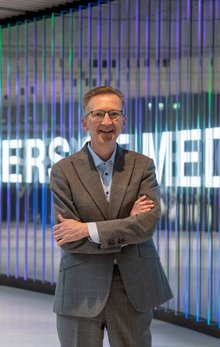
Steffen Lang
President, Operations