For decades, pharmaceutical discovery has been synonymous with scientists in white coats, test tubes and laboratory benches.
As technological momentum accelerates, that picture is changing. AI, automation, computational biology and increasingly sophisticated data platforms are reshaping how medicines are conceived, tested and refined – sometimes moving research beyond the physical laboratory altogether.
Yet traditional scientific environments remain crucial, increasingly incorporating digital capabilities into their workflows.
From AI-native organisations and hybrid experimental platforms to sprawling pharmaceutical research campuses, these 10 research labs represent different visions of the future. Together, they indicate how the boundaries between the physical and virtual laboratory are becoming increasingly blurred.
10. Relay Therapeutics – Dynamo Platform
HQ: Massachusetts, US
Total Employees: Around 200
CEO: Sanjiv Patel

Relay Therapeutics’s Dynamo platform puts protein motion at the centre of drug discovery, combining physical wet-lab experimental science with computational modelling and machine learning.
Rather than relying on static snapshots of proteins, Dynamo captures their dynamic behaviour to identify previously hidden binding sites and therapeutic opportunities.
Relay currently has five candidates in its Dynamo platform pipeline.
Its integrated workflow moves from understanding a target, through virtual and experimental screening, to lead optimisation – effectively bringing computation, experimentation and drug design together in a hybrid research ‘lab’ environment.
9. Isomorphic Labs – AlphaFold
HQ: London, UK
Total Employees: 430
CEO: Sir Demis Hassabis

Born from DeepMind’s AlphaFold breakthrough, Isomorphic Labs is building an AI-native approach to drug discovery focused on oncology and immunology.
AlphaFold 3 gives researchers an atomic-level view of how proteins, DNA, RNA and drug-like molecules interact, allowing hypotheses to be tested computationally in seconds rather than through lengthy experimental processes.
The company is now building beyond AlphaFold towards a unified Drug Design Engine, combining multiple AI models to identify targets and design potential medicines across therapeutic areas and modalities.
8. Recursion – OS
HQ: Utah, US
Total Employees: 580
CEO: Najat Khan

Recursion’s OS blurs the boundary between the physical laboratory and the digital world, linking automated wet-lab experiments with AI models in a continuous learning loop.
Its robots generate vast quantities of biological and chemical data, while machine learning analyses those results to identify targets, design molecules and guide the next experiments.
With up to 2.2 million experiments conducted each week, the platform effectively turns the laboratory into a data-generating engine for drug discovery, accelerating the journey from biological insight to medicine.
7. Genentech – South San Francisco Campus
HQ: California, US
Total Employees: 12,100
CEO: Ashley Magargee

Roche-affiliated Genentech’s South San Francisco campus has been a cornerstone of biotech innovation for five decades, but its next chapter is increasingly digital.
Set for construction between 2027 and 2033, the Genentech Research and Early Development (gRED) Centre will add 1.25 million sq ft to the existing campus and is being designed around "lab-in-a-loop" drug discovery, bringing AI, automation and computational science directly into the laboratory environment.
The campus is also becoming a testbed for Roche’s wider push towards autonomous AI laboratories.
6. Boehringer Ingelheim – Biberach
HQ: Ingelheim, Germany
Total Employees: 54,000
Chairman of the Board of Managing Directors: Shashank Deshpande

Boehringer Ingelheim’s Biberach site in southern Germany is the company’s largest research and development centre, bringing discovery science, biopharmaceutical development and advanced analytics together under one roof.
More than 7,600 on-site employees span small-molecule discovery, biologics, genetics, proteomics and translational science, increasingly combining laboratory experimentation with computational and data-driven approaches.
From hands-on medicinal chemistry to predictive modelling and human genetics, Biberach demonstrates how the modern pharmaceutical lab is evolving without losing sight of its physical scientific foundations.
5. Novo – Måløv Research Centre
HQ: Bagsværd, Denmark
Total Employees: 69,500
CEO: Maziar Mike Doustdar
Novo’s Måløv Research Centre is its largest research site, focusing on early drug discovery, protein and peptide engineering, formulation and preclinical testing.
Originally opened in 1991 with roughly 300 employees, the campus has expanded to accommodate over 2,300 personnel, mirroring Novo’s expansion into one of the world’s largest pharmaceutical firms.
Next, Novo plans to construct an 8,500-square-metre logistics and warehousing expansion on-site. The centre’s scientists work across chemistry, biology and advanced therapeutic platforms, with hands-on experimentation remaining central to discovery.
4. Pfizer – Groton, Connecticut R&D Facility
HQ: New York
Total Employees: 75,000
CEO: Albert Bourla

Pfizer’s Groton R&D facility is one of the pharmaceutical industry’s largest research campuses, spanning 2.17 million sq ft of laboratory and office space across 175 acres.
Around 3,000 employees work across its specialist laboratories, vivarium and clinical manufacturing facilities, covering medicinal chemistry, pharmacology, pharmaceutical sciences and drug safety.
Nearly every Pfizer medicine is developed in part at Groton, making the campus a critical bridge between discovery science, advanced development and the company’s global pipeline.
3. Novartis – Novartis Campus
HQ: Basel, Switzerland
Total Employees: 75,000
CEO: Vasant Narasimhan
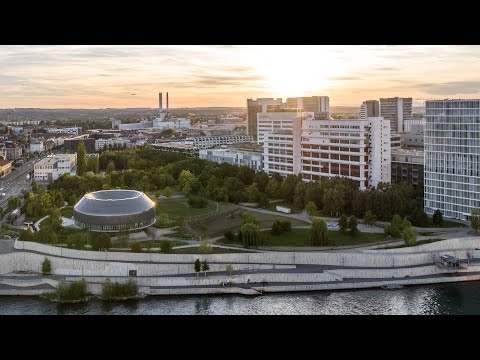
Novartis’ Basel campus is the heart of its Biomedical Research operation, with around 5,000 R&D specialists based in the city and roughly 8,000 Novartis employees working across the innovatively-designed campus.
The research environment spans oncology, immunology, neuroscience and cardiovascular, renal and metabolic disease, combining fundamental biology with advanced drug-discovery technologies.
Its collaborative model extends beyond the campus, with more than 100 active research and preclinical partnerships across Switzerland, reinforcing Basel’s role as a global life sciences hub.
2. AstraZeneca – The DISC
HQ: Cambridge, UK
Total Employees: 96,000
CEO: Pascal Soriot

AstraZeneca’s Discovery Centre (DISC) in Cambridge is a £1bn (US$1.35bn) research facility bringing more than 2,000 scientists together across drug discovery and development.
When the DISC opened in 2021, CEO Pascal Soriot said the facility "raises the bar for sustainable R&D and global collaboration across our industry".
"It will allow us to break new boundaries in the understanding of disease biology, bring life-changing medicines to patients and power the next stage of our company’s growth," he added.
Designed around collaboration, the site combines advanced biology with AI, data science, robotics and precision medicine to accelerate the search for new treatments.
Its high-throughput capabilities can screen up to one million compounds a day, while more than 90% of AstraZeneca’s small-molecule discovery pipeline now uses AI to optimise molecular design.
With academia, hospitals and biotech partners on its doorstep, the DISC is built to turn scientific insight into medicines at scale.
1. Roche – pRED Innovation Centre Basel
HQ: Basel, Switzerland
Total Employees: 103,000
CEO: Thomas Schinecker

Roche’s pRED (Pharma Research and Early Development) Innovation Centre in Basel brings around 1,800 researchers together across 58,900 sq metres of laboratory and office space, creating a physical hub for the company’s global drug-discovery efforts.
Roche CEO Thomas Schinecker said the centre would "boost the effectiveness and efficiency of our R&D" and "deliver the greatest impact for patients" at the time of its opening in 2024.
The centre houses 150 labs across two high-rise laboratory buildings, combining advanced technologies with flexible spaces designed to encourage collaboration between biologists, chemists, clinicians and data scientists.
That convergence is becoming increasingly digital: Roche is now pursuing autonomous, AI-driven laboratories and committing around US$2.4bn into the programme as it aims to connect computational intelligence with physical experimentation.
Its Basel centre therefore offers a glimpse of where pharmaceutical research may be heading next.